





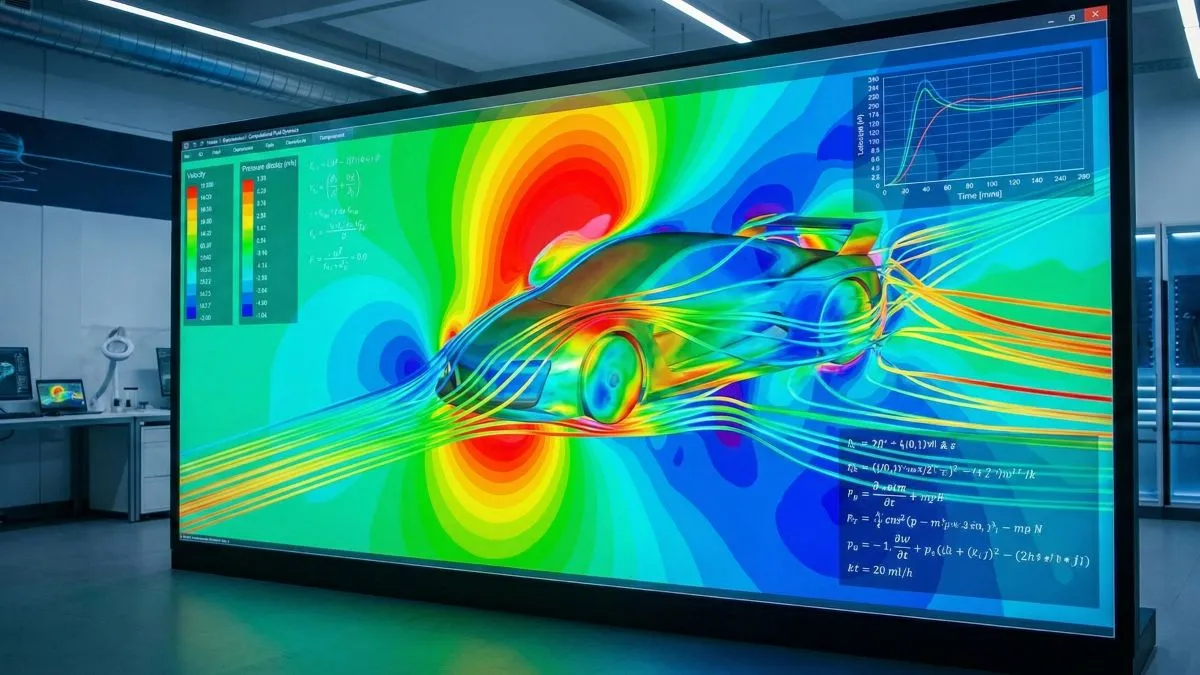
Computational Fluid Dynamics (CFD) has become an essential technology for engineers who need to understand how fluids, heat, and gases behave in real-world systems. From automotive design and aerospace engineering to energy systems and manufacturing, CFD simulation helps professionals test designs, identify performance issues, and make informed engineering decisions before physical prototypes are created. For anyone new to this field, an Ansys Fluent beginner course can provide a structured pathway from basic concepts to practical simulation skills.
Understanding the Fundamentals of CFD
Before opening simulation software, beginners should understand what CFD actually does. Computational Fluid Dynamics uses numerical methods to solve equations that describe fluid flow, heat transfer, pressure, velocity, and other physical phenomena.
Instead of building multiple physical prototypes, engineers can create a digital model and evaluate different operating conditions. This can reduce development time and help identify potential design improvements.
A good beginner learning path introduces fundamental concepts such as conservation of mass, momentum, and energy. Students also become familiar with concepts including pressure, velocity, turbulence, viscosity, boundary conditions, and fluid properties.
Understanding these fundamentals makes it much easier to interpret simulation results rather than simply relying on colorful contours or graphs.
Getting Started With Ansys Fluent
Ansys Fluent is widely used for advanced fluid-flow and heat-transfer simulations. However, its extensive capabilities can initially appear overwhelming to new users. A structured Ansys Fluent beginner course helps learners become familiar with the interface and simulation workflow step by step.
The first stage generally involves understanding the overall process. A typical CFD workflow includes creating or importing geometry, generating a computational mesh, defining materials, selecting physical models, establishing boundary conditions, solving the equations, and post-processing the results.
Learning this workflow early gives beginners a clear understanding of how individual software features fit together.
Preparing Geometry for Simulation
Geometry preparation is one of the first practical steps in CFD. A simulation model should represent the physical problem accurately while avoiding unnecessary complexity.
For example, a beginner working on airflow through a pipe may not need every small mechanical detail surrounding the pipe. Removing unnecessary features can make meshing easier and reduce computational requirements.
Students learn how to inspect geometry, identify fluid regions, create appropriate computational domains, and prepare models for meshing. This stage also teaches an important engineering lesson: simulation quality depends heavily on how appropriately the physical problem has been simplified.
Learning the Importance of Mesh Generation
Mesh generation is one of the most important parts of CFD simulation. The computational domain is divided into many smaller cells, and the governing equations are solved across these cells.
A beginner course explains different mesh concepts and helps learners understand why mesh quality matters. Poor-quality cells can negatively affect numerical stability and accuracy, while an excessively fine mesh can increase computational cost without providing meaningful benefits.
Beginners should learn to examine parameters such as cell size, skewness, orthogonal quality, and refinement around important regions.
Areas where gradients are expected to be strong, such as near walls, sharp corners, or separation zones, may require additional mesh refinement. Learning how to balance accuracy and computational efficiency is an important professional CFD skill.
Defining Materials and Physical Models
After preparing the mesh, the next step is to describe the physical characteristics of the simulation. This may involve selecting air, water, oil, gases, or other fluids and specifying properties such as density and viscosity.
Depending on the problem, users may also need to select appropriate models for turbulence, heat transfer, multiphase flow, radiation, or other physical effects.
An effective Ansys Fluent beginner course does not simply teach users which buttons to select. It should explain why a particular model is appropriate for a specific engineering problem.
This distinction is important because choosing an unsuitable physical model can produce results that look convincing but do not accurately represent the real system.
Setting Boundary Conditions
Boundary conditions define how the fluid interacts with the computational domain. Common examples include velocity inlets, pressure outlets, walls, mass-flow boundaries, and symmetry conditions.
For beginners, boundary conditions can initially be confusing because they require both software knowledge and an understanding of the physical system.
A practical learning approach demonstrates boundary conditions using simple examples. For instance, learners might simulate air entering a duct at a specified velocity and leaving through an outlet at a known pressure.
Through such exercises, students begin to understand how physical assumptions are translated into numerical inputs.
Running the CFD Solution
Once the setup is complete, the solver calculates the flow field. Beginners are introduced to concepts such as initialization, iterations, convergence, residuals, and solution monitoring.
Convergence is particularly important. A simulation should not be considered reliable simply because the solver has completed a specified number of iterations. Learners need to examine residual trends and relevant physical quantities to determine whether the solution has stabilized sufficiently.
A structured course can also introduce common solver problems, including unstable calculations, unrealistic boundary conditions, poor mesh quality, and inappropriate numerical settings.
Understanding CFD Results
Post-processing transforms numerical data into information that engineers can understand and use. Fluent provides tools for examining velocity contours, pressure distributions, temperature fields, streamlines, vectors, and other results.
Beginners should learn to ask engineering questions rather than simply look at graphics.
For example, where is the pressure drop occurring? Are there regions of flow separation? Is the temperature distribution reasonable? Are velocity patterns consistent with the expected physics?
This analytical approach helps learners develop professional CFD judgment.
Building Skills Through Practical Projects
The most effective way to learn CFD is through repeated practice. After completing introductory exercises, learners can progress to projects such as internal pipe flow, external airflow, heat-transfer problems, mixing systems, or flow around simplified automotive components.
Each project reinforces the complete simulation workflow.
A good Ansys Fluent beginner course should gradually increase complexity rather than introduce advanced models immediately. Starting with a simple problem allows students to understand the relationship between geometry, mesh, setup, solver behavior, and results.
As confidence grows, learners can move toward more complex simulations involving turbulence, transient flows, conjugate heat transfer, multiphase systems, and other advanced applications.
Developing Professional CFD Habits
Learning software commands is only one part of becoming proficient in CFD. Professional users also develop habits that improve reliability and efficiency.
These include checking geometry carefully, evaluating mesh independence, validating results against analytical calculations or experimental data, documenting assumptions, and reviewing whether results make physical sense.
Simulation verification and validation are particularly important. A numerical result is not automatically correct simply because the solver produces a converged solution.
Engineers should compare simulation outcomes with known theory, experimental measurements, published data, or appropriate benchmark cases whenever possible.
Why Beginners Should Follow a Structured Learning Path
Trying to learn Fluent without a clear progression can be challenging because the software contains many features designed for different engineering applications. Beginners may spend significant time learning isolated functions without understanding the overall CFD methodology.
A structured course provides a logical progression from fundamentals to practical applications. Students can first understand CFD concepts, then learn geometry and meshing, followed by setup, solution methods, post-processing, and validation.
This approach creates a stronger foundation and makes it easier to transition toward advanced engineering simulations.
Conclusion
An Ansys Fluent beginner course can be an effective starting point for students, engineers, researchers, and technical professionals who want to develop practical CFD capabilities. By following a step-by-step process, learners can move from understanding basic fluid mechanics to creating complete simulations and interpreting engineering results.
The key is to focus not only on operating the software but also on understanding the physics behind every simulation decision. With consistent practice, careful validation, and progressively challenging projects, beginners can build the technical foundation needed to use CFD simulation more confidently in professional engineering environments.