





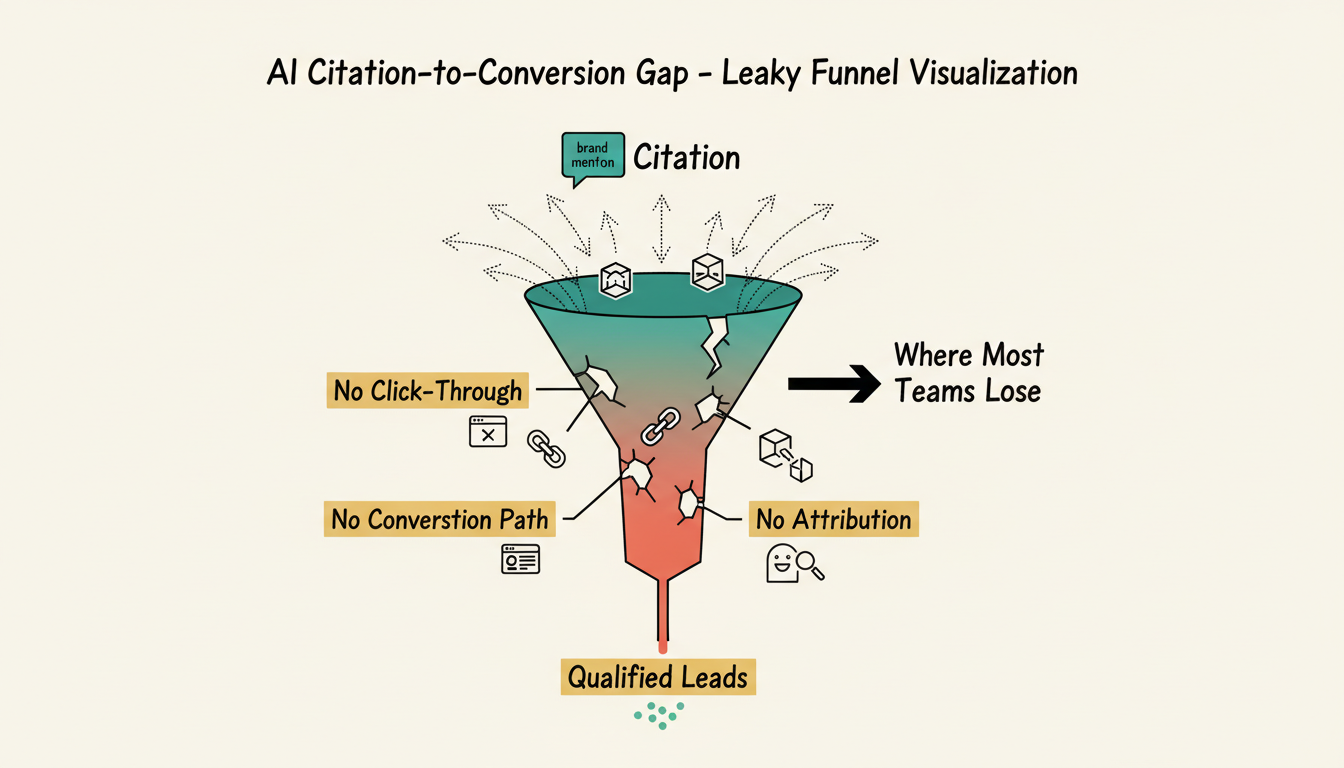
Your brand just appeared in a ChatGPT response. A potential buyer read your name alongside two competitors. Then they closed the tab. No click. No conversion. No lead.
Getting cited by AI models is only half the battle. The real challenge is converting those citations into qualified pipeline. Most teams celebrate AI mentions without building the infrastructure to capture the demand those mentions generate.
What Most Teams Miss About AI Citations
Answer engine optimization tools help you track when and where AI models mention your brand. But tracking alone doesn’t generate revenue. The gap between citation and conversion is where most teams lose.
AI search behaves differently from traditional search. Users often get their answer without clicking through. They form brand impressions passively. Your conversion funnel needs to account for this new behavior.
Teams that optimize for mentions without optimizing for conversion are building awareness they can’t monetize.
An AI citation without a conversion path is a billboard on an empty highway. Visibility means nothing without a way to capture demand.
What Effective Citation-to-Lead Conversion Requires
Intent-Matched Landing Experiences
When a user does click through from an AI citation, they arrive with specific context. They already read a comparison or recommendation. Your landing page needs to match that context exactly.
Build dedicated pages for each major AI citation scenario. If ChatGPT mentions you in a comparison, the landing page should address that exact comparison and advance the buyer to the next step.
Multi-Touch Attribution Modeling
AI citations influence decisions even when they don’t generate direct clicks. A buyer who sees your brand in three ChatGPT responses over two weeks and then Googles you directly looks like an organic lead. Without proper attribution, you’ll never credit the AI citations that actually drove the conversion.
Build attribution models that account for AI-assisted touchpoints alongside traditional channels.
Citation Quality Over Quantity
Not all AI mentions are equal. A citation that positions your brand as the recommended solution is worth ten that list you as one option among many. Focus your optimization efforts on earning decisive citations where the AI model frames you as the answer rather than an option.
Integrated Demand Capture Across Channels
The best results come from teams that coordinate AI citation strategy with paid media retargeting, email nurture, and direct outreach. When a prospect encounters your brand in an AI response, your paid ads reinforce the message. Your email sequence addresses the same pain points. This creates a cohesive buyer journey that converts. Working with aeo services providers who run full-funnel strategies ensures no touchpoint operates in isolation.
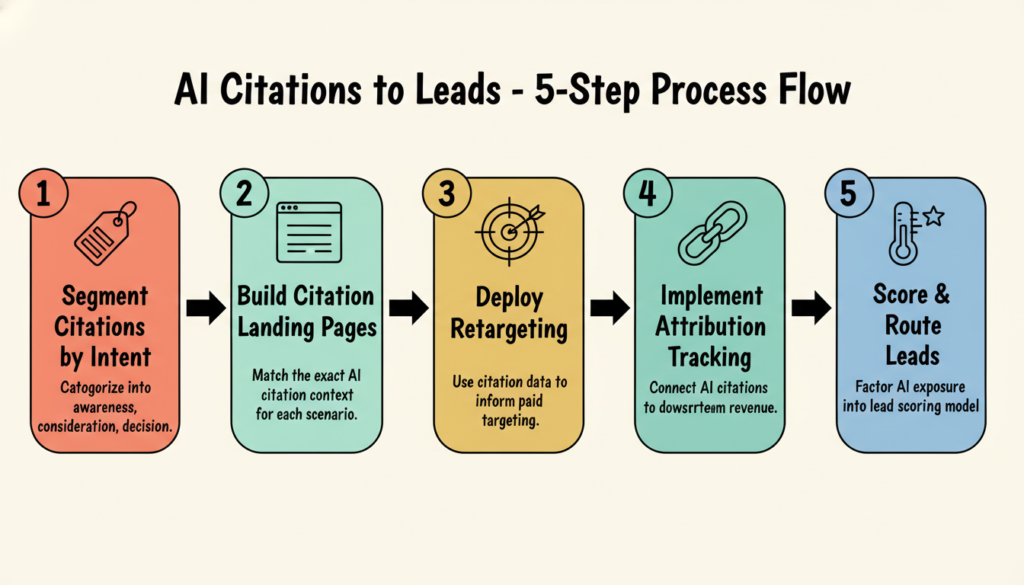
A Process for Converting Citations to Pipeline
- Segment your AI citations by intent. Categorize mentions into awareness, consideration, and decision stages. Each stage needs a different conversion approach.
- Build citation-specific landing pages. Create pages that match the context of your most valuable AI mentions. Reference the exact problem the AI response addressed.
- Deploy cross-channel retargeting. Use your AI citation monitoring data to inform paid media targeting. If ChatGPT recommends you for a specific use case, run ads to that same audience segment reinforcing the recommendation.
- Implement assisted-conversion tracking. Work with answer engine optimization tools and aeo services teams who can build attribution models that connect AI citations to downstream revenue, not just traffic.
- Score and route AI-influenced leads. Add AI citation exposure as a factor in your lead scoring model. Prospects who encountered your brand through multiple AI responses are warmer than cold outreach targets. Route them accordingly.
What Happens When You Get This Right
Teams that build citation-to-lead infrastructure see a specific pattern. Their cost per qualified lead drops because AI citations are essentially earned media. Their conversion rates increase because prospects arrive pre-educated and pre-disposed.
The math favors this approach. Paid acquisition costs keep rising. AI citation costs stay flat once you’ve built the authority. Over time, the delta between paid CAC and AI-sourced CAC widens in your favor.
Teams that ignore citation conversion will watch competitors capture the demand their AI presence generates. The brands appearing in AI responses alongside you have the same opportunity. The question is which brand builds the better conversion infrastructure first.
Every AI citation is a moment of influence. Build the systems that turn influence into revenue or accept that your competitors will.