

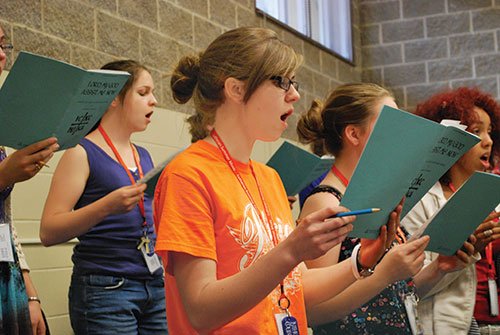
Choral singers practice at home with what’s available: the full recording of the piece, a piano accompaniment track, or their memory of how their part sounded in rehearsal. None of these options gives them what they actually need — the ability to hear their specific voice part isolated from the full choral blend, so they can internalize their line without the other parts masking it.
This is a foundational problem in choral music education. The soprano line, the bass line, the tenor harmony — each part has musical logic that’s clear in isolation and indistinct in the blend. Home practice that relies on full-recording listening produces singers who can follow the music but can’t hold their part independently when the other voices are stronger around them.
Stem isolation changes the practice material available without requiring expensive part-specific recordings for every work.
Why Part Confusion Happens in Choral Practice?
The acoustic masking problem in choral music is severe. Four or more voice parts occupy the same fundamental frequency range — all human voices, regardless of voice type, produce content between roughly 80Hz and 1100Hz for their fundamental pitches. The parts are harmonically related by design, which means they share overtones as well.
When a soprano is trying to learn their line by listening to a full choral recording, they’re hearing that line competing with three other parts whose pitches are specifically chosen to blend with it. The part that needs to be learned is the part most successfully masked by the surrounding harmony.
This is why choral singers who practice from full recordings often arrive at rehearsal knowing approximately how their part goes but uncertain about specific pitches in the passages where the harmony is densest — exactly the passages where accurate part knowledge matters most.
In the blend, every part serves the chord. In isolation, each part becomes audible as a melody.
What Isolated Vocal Stems Provide for Choral Rehearsal?
Part-Specific Practice Audio From Any Recording
A stem splitter applied to a choral recording separates the vocal content from accompaniment. This isn’t a perfect four-way separation of SATB voices — the voice types overlap in frequency and blend acoustically — but it does produce audio that isolates vocal content from instrumental accompaniment, and in many cases separates lead voices from supporting harmony.
For choirs learning a piece, this provides a vocal-only practice track that’s more useful than the full mix for part internalization. The accompaniment is removed, which makes the choral harmony more clearly audible, and the harmonic relationships between parts are easier to follow.
Accompaniment-Removed Practice for All Sections
Sectional practice at home is often constrained by the accompaniment-heavy nature of available recordings. Isolated vocal stems allow sectional members to practice against the vocal blend rather than against an orchestral or piano accompaniment that can mask their part.
The ai splitter result gives choir members a practice track that is closer to what they’ll hear in a choir room — surrounded by voices — rather than what they hear from a commercial recording.
How Choir Directors Can Implement Stem-Based Practice?
Create practice tracks for each major work in the season. For each choral work the ensemble is rehearsing, produce both a full-vocal stem and an accompaniment stem. Distribute the vocal stem to all sections for home practice.
Use the isolated vocal stem to identify problem passages before rehearsal. Listening to an isolated vocal stem of a professional recording reveals the specific musical content — the voice-leading, the dissonances that need to tune correctly, the passages where parts move in contrary motion. This analysis informs where to focus rehearsal time.
Pair isolated stems with sectional recordings. Record each section of your choir separately in rehearsal, then distribute both the professional isolated stem and your own sectional recording. Singers can compare their section’s output to the professional reference using the same stem format.
Teach students how to use stem tools for independent study. Part of developing musically independent singers is giving them tools to diagnose their own accuracy. Teaching choir members to compare their singing to an isolated stem reference builds ear training into home practice.
Frequently Asked Questions
Why do choral singers struggle to learn their parts from full recordings?
All human voice types produce fundamental pitches in roughly the same frequency range, and the parts are harmonically related by design, meaning they share overtones as well. When a soprano is trying to learn their line from a full choral recording, they’re hearing it competing with three other parts whose pitches are specifically chosen to blend with it. The part that needs to be learned is the part most successfully masked by the surrounding harmony — which is why singers who practice from full recordings arrive at rehearsal uncertain about specific pitches in the densest passages, exactly where accuracy matters most.
What does vocal stem isolation provide for choir practice that full recordings don’t?
Applying a stem splitter to a choral recording separates the vocal content from instrumental accompaniment, providing a vocal-only practice track that makes the choral harmony more clearly audible. The accompaniment is removed, which makes the harmonic relationships between parts easier to follow. Sectional members can practice against the vocal blend rather than against an orchestral accompaniment that can mask their part — the result is a practice track closer to what they’ll hear in a choir room than what a commercial recording provides.
How should choir directors implement stem-based practice materials?
Create both a full-vocal stem and an accompaniment stem for each choral work in the season, and distribute the vocal stem for home practice. Use the isolated vocal stem from a professional recording to identify problem passages before rehearsal — voice-leading moments, passages where parts move in contrary motion — and target rehearsal time accordingly. Record each section separately in rehearsal and distribute both the professional isolated stem and the sectional recording so singers can compare their section’s output to the professional reference using the same format.
The Practice Quality That Comes From Part Clarity
Choral directors know the rehearsal pattern: a passage that was difficult last week becomes clearer after singers have spent time with the piece at home. The quality of home practice determines how much rehearsal time gets spent fixing problems versus developing interpretation.
Practice material that gives singers clearer access to their specific part produces home practice with more diagnostic value. Singers who can hear their part clearly — not approximated through a full choral blend — arrive at rehearsal with more accurate pitch memory and more confidence in the passages that were uncertain before.
Stem isolation isn’t a substitute for sectional rehearsal. It’s the home practice quality improvement that makes sectional rehearsal more productive.